


PAUL PETERSON, HOST:
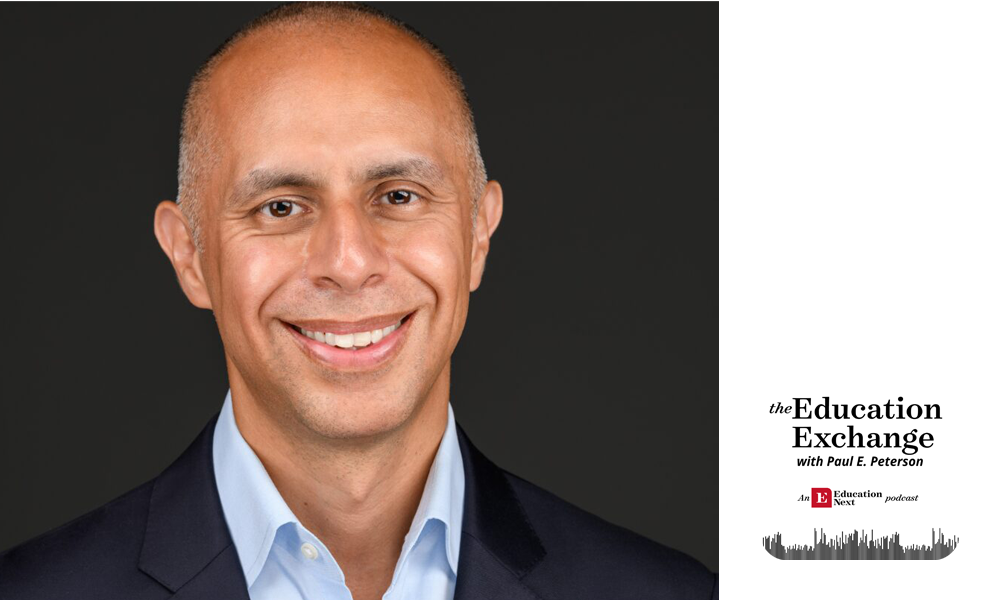
This is the Education Exchange with Paul Peterson. I am the director of the Program on Education Policy and Governance at Harvard University. Thank you for joining me. Democrats won a resounding victory on November 2nd, capturing not only the Senate and the House of Representatives, but many state and local offices that are critical for shaping school policy over the next two years. But what will Democrats accomplish with their newfound power in Washington and in state capitals across the country? To discuss that question, I am fortunate to have with me today on the Education Exchange, Jorge Elorza, the Chief Executive Officer for Democrats for Education Reform. He previously served for eight years as the mayor of Providence, Rhode Island, so he knows a lot about school reform and school quality at the local level. Thank you, Jorge, for joining me on the Education Exchange.
JORGE ELORZA: My pleasure to be here, Professor.
PETERSON: Jorge, Democrats are currently enjoying their landslide victory on November 2nd. Was this a strictly national election? Is this a vote expressing economic discontent or a vote against President Trump and his policies? Or were there state and local issues on the ballot as well?
ELORZA: From my perspective, I think it’s pretty clear that it’s a repudiation of Trump. Folks are concerned about inflation. They’re concerned about the cost of just about everything. They’re concerned about corruption. They’re concerned about the dilution of the Black vote. They’re concerned about ICE raids in major cities. So all of this is working against a very unpopular candidate. So I think that that’s a big part of it. But I think that Democrats actually deserve a lot of credit in this election. I think that there’s been a great deal of . . . I think the party has evolved. And I would say there’s been a great deal of maturation since the last election. During the last election, there was still a lot of talk about purity tests. “Are you really a Democrat?” And I think that across the map, you see very different kinds of Democrats running in this elections and in their races. And there’s an understanding that in order to win, even if you hold certain values, your policy positions are going to differ. So I live in Rhode Island. I’ve actually never been to Alaska, but my sense is that people are different there than they are in Rhode Island. We’re a very big country, and our party has to allow that big tent that allows for that variation from state to state. So mostly I think it’s a repudiation of Trump, but it also shows some maturation by the party in allowing us to have a bigger tent.
PETERSON: Well, so how important was education in these debates and in the discussions leading up to the election? And how has the outcome of the election affected people’s thinking about education? Because I can imagine that the major shift, the major landslide that has occurred might induce people to think about things in a somewhat different way than they would just even two days ago.
ELORZA: Yeah. You know, what’s the phrase? Something like graveyards are littered with electeds who overread their mandates. And I think the Democrats really have to be careful. And as we diagnose this victory, let’s understand that a big part of this was a repudiation of Trump. That’s first. The second is, let’s remember that, unfortunately, education is not one of the highest salience issues, meaning it’s not one of the issues that drives people to vote in the same way that, say, inflation does, the cost of housing, the cost of gas, etc. And so I think that education was and always is impactful at the margins, but it’s not a main driver in the way that other issues are. So it can’t be said that Democrats won because of their stance and their position on education. The third point is, most Americans, when we think about politics, our mind automatically defaults to what happens in D.C. And that’s understandable. That’s what gets most of the airtime, most of the attention, right. The president’s always on television. But the reality is that for our issue, for education, the most important policymakers are state governors. It is by and large a state issue. And yesterday’s election is really interesting. We’re going to have 12 new Democratic governors. There’s likely going to be another two once Alaska and Kansas are called. And so you have a new generation of Democrats stepping up and being elected for governor. And they’re relatively new to thinking deeply and critically about K–12 education. And so it’ll be interesting to see how they develop their K–12 education visions. At the same time, what’s really interesting about this election is, in our world, so much has been made of Republican-led states that have adopted or expanded these flexible funding tools like ESAs and universal ESAs, sometimes tax credits. Now you have Democrats taking over the governorship in these states, and they’re familiar with them, and so they’ve seen how they work and how they don’t work. So I’m thinking about states like Georgia. I’m thinking states like Ohio, Iowa. They’re going to have a Democratic governor, a new Democratic governor, but they have existing broad choice programs. It’ll be interesting to see how they approach that. I think that repealing these bills is out of the question. And so it’ll be interesting to see how the left, Democrats, put their stamp on a form of choice that helps accomplish and advanced progressive values. So while there has been little heterogeneity in the K–12 education discussion on the left, I think that’s going to change. There’s going to be a lot more discussion on K–12, but also different conversations happening in K–12 with the most important policymakers, governors.
PETERSON: Well Democrats have been supporting free college. And they’ve been supporting expansion of preschool programs and universal preschool programs. But they haven’t really done a lot more about … in their conversation and you don’t hear much about K–12 education, what needs to be done during those critical 13 years that students are in the school system we have today. Do you think they’re going to develop a clearer identity in that space?
ELORZA: So I think in the spirit of never letting a good crisis go to waste, I do think that there is this really remarkable opportunity right now. And that’s for two reasons. The first is that so much more attention has been brought to not only the political imperative of Democrats refocusing on K–12 education. But the extent, the scale of the crisis is now impossible to ignore. Whereas elected officials over the past decade, they could get away without having an education agenda. That’s becoming increasingly difficult. And so taking advantage of that is one. And then the second thing is that, as you allude to, Professor, Democrats just haven’t talked about K–12 education over the past 10 years. Really, it’s been since the last year or so of the Obama administration, 2015, the last time the Democrats even talked about K–12. And so there’s a void. There is no vision. There is no agenda. But the flip side to that is that the folks coming into office, the governors coming into office right now, I don’t think that they have made up their mind of exactly what their approach and vision on education is going to be. And so that’s a void to be filled. I see that as an incredible opportunity for folks that want to disrupt and dislodge the unacceptable status quo.
PETERSON: Well, there’s been a lot of opposition within the Democratic Party to the new federal education tax credit program. And some people say that actually it’s with a new big majority in Congress, it’s possible for the new Congress to actually reverse this tax scholarship program that was enacted as part of the Big Beautiful Bill that the Republicans pushed through. Do you think that this is a possibility in the next Congress?
ELORZA: No, I don’t think so. I think without the White House, it’s going to be impossible to repeal something like this. Trump will always veto it. And Democrats don’t have a veto-proof majority. And so I think it’s safe for the next couple of years. This is a great area where some heterogeneity is really important for our party. So I’m encouraged by the fact that many Democratic governors, they continue to keep an open mind about participating in the program. And I do anticipate that now that the election is done, we’re going to see more Democratic governors opt in. A very, very, very wise friend of mine, Ravi Gupta, made this point to me a while back. And he said, “There’s a good chance that 10 years from now, Democrats are the ones that will be for this and Republicans will be the ones that are against this.” I think that it makes sense for Democrats today to participate and opt into it because there’s so many ways that it can be used to advance their own priorities within their states. And what I think will happen, what I also hope will happen, is that Democrats will see these flexible funding tools, how they can be used to advance their priorities, they’re going to like it, and they’re going to want more of it.
PETERSON: Well, of course, there are some Democratic governors who’ve already signed up for this federal tax credit program. And as you have mentioned, the governor is critical. The actual legislation gives the governor the authority to decide whether or not this program is going to operate within their state. And in Colorado and New York State, you already have two Democratic leaders who have said they’re going to support this. So whether or not that’s going to continue in Colorado is up for grabs. So do you think there’s some significant number of the new Democratic governors are going to say, yes, let’s go forward with this?
ELORZA: I do believe so. And I think the reason for that is because it’s just such a no brainer. So put aside the school choice and all those debates aspect of it, which are incredibly important. But put that aside for a second. You know, participating in the program is really, really simple. It’s a tax credit. If a governor opts out, that means that by default. hundreds of millions, in some cases, multiple billions of dollars will automatically leave your state. If you opt in, you can capture as much of that as possible and put it to use so that your kids benefit. You know, that’s about as simple a decision as it gets in this world. And so why would you voluntarily let the money leave? And the general public really isn’t very aware of this program yet. It hasn’t even kicked in. But once it does kick in and there’s more public awareness of it, I think it’s going to be politically unsustainable for governors to continue to opt out. They’re going to be asked the question repeatedly by their voters, “Governor, why do you think it’s better for our money to leave to support kids in other states or go straight to the Treasury, as opposed to being used to support our kids? It makes no sense. And I think it’s going to be hard for governors to continue to justify that.
PETERSON: Well, Texas could be a key state in this. It’s a big state. It’s a major change in the politics of Texas with all Democrats coming into a whole range of statewide positions. It’s not just the Senate seat. It’s the gubernatorial chair as well and many other statewide offices. And I don’t know what’s happened at the legislative level, but probably a significant change has happened there as well. If you look at Texas, they were sort of late to come into this tax credit school choice undertaking. Are they going to turn in a new direction?
ELORZA: We’ll see. And it depends on where the Texas legislature ultimately lands. My sense is that they will have divided government in Texas. And if they do, it’s going to be really hard to repeal it. Although Texas is an interesting case, it’s not like other states that have had it for a few years and they have a built in constituency. You know, Texas is just getting going right now. I know it had a pretty broad participation, but is it enough to have that constituency that’s going to fight for it and demand that it continues? My guess is that in all states that have gone universal with their ESA programs is that Democrats will try to tweak them to provide more … to provide certain guardrails. And I think that academic accountability is at the top of that list. But once these programs are in place, they’re popular, right? They empower families to make their own decisions. And so I think it’ll be very, very difficult to entirely do away with. But Paul, if we get to the point where Democrats are having the conversation of what kind of choice program best aligns with our priorities, that’s a massive step forward for Democrats, because up until this point for the past 10 years, we haven’t talked about K–12 at all. And to the extent that we have talked about these choice programs, the party has moved away from charter schools. It’s been unwilling to even have a conversation about ESAs. But if instead the conversation is like, “What tweaks do we need to help them advance our priorities?” that’s a significant step forward.
PETERSON: Well, of course, the teacher union is very much opposed to this scholarship program and to a lot of other changes, even accountability in K–12. It’s extremely important for the infrastructure of the Democratic Party. They provide a lot of soldiers on the ground and they provide a lot of contributions to candidates. So isn’t that going to be an important constituency that any Democratic leader has to take into account?
ELORZA: Absolutely. And that’s why the fact that we have so many new governors is such an important development. So our whole theory of the case is that It’s executives who set the agenda. They’re the ones who provide policy guidance and they’re the ones that provide political cover. And unfortunately, with education, the political incentives just don’t align. So, you can wade into education reform. The potential benefits, the potential payoff, both policy wise and political are uncertain. Whereas if you upset the teachers union, there’s a certainty that there’s going to be a political penalty to pay. And so that asymmetry makes it very challenging. But what we look for are governors whose convictions are their own—not governors who are going to follow wherever the political winds are blowing, but governors that are going to prioritize K–12 education because they’re determined to lead and they think it’s the right thing. And I think that there will be a handful, if not more, of new governors that come in and want to do something with K–12, not because the politics push them to, but because the convictions are their own and they want to lead.
PETERSON: Well, Jorge, you’re the chief executive officer of the Democrats for education reform, and you’ve been the mayor of a big city and you know all the problems of the urban school. How is DFER, or the Democrats for Education Reform, how is DFER positioning itself in this new space that has been created by this election?
ELORZA: Yeah. So again, I think there’s incredible opportunity with the new governors and with returning governors. There are a number of returning governors that have been doing some really interesting work. And what we want is for governors. to have to accelerate their learning curve so that they know a little bit of the history, but also what they can do without new legislation and without additional resources. There’s a lot that they can do if they prioritize it. Second, they also need to know just certain basics. You know, it’s 2026, science of reading. And the suite of supports that surround it, that needs to be fingertip knowledge for governors. And so they need to know that. Second there’s been a lot of really interesting work done around the southern surge with best practices with modern day accountability systems. New governors need to know what this looks like and how their states compare to it. And they also have to understand their state’s budgets. If you don’t know where the money is going, then you’re really not in a position to make strategic decisions. And so what we want to do is find the governors that don’t need to be pushed. They want to lead on education. And we want to be wind at their sails—help them accelerate their learning curve and then support them so that they’re ready when they submit their first budgets. to show their states and to show the country that they’re ready to lead on K–12.
PETERSON: Well, so you mentioned budgets and finance is a huge issue. And the question is, how is the Democratic Party going to position itself, given the affordability issue that’s out there, how are they going to position it? Do they want to increase taxes to put more money into our schools? Are they willing to go to the voters and say, we’re asking you to pay more in so that we can provide more resources to our schools. Is that part of the Democratic agenda going forward?
ELORZA: The beauty of our system is that we have a federalist system. I imagine there will likely be states that do nothing but just more money, more money, more money for more of the same. And there’ll be states that do something very different. Some might say, “No, we have declining enrollment. What we need to do is either tighten our belts or hold our districts and our school systems accountable.” And I’m sure there will be governors in between as well that say, “No, we actually want to invest more. This is the most important investment that we can make, but it comes with strings attached.” If I’m going to be asked as a governor to make additional investments, what can I reasonably expect from this and be able to gauge whether the investments are paying off? So we’re going to see a number of different approaches, but I’m excited with this new crop of governors. There are a number of really impressive leaders there. And there’s a crisis that can no longer be ignored. And it’s about time that we as a party get back on our front foot. And it’s the governors that are going to lead us there.
PETERSON: Well, how about the desegregation issue? In New York City these days, there’s a lot of talk about this city being highly segregated, the high schools being segregated, that the choices being made in New York are reinforcing segregation. Is desegregation going to reemerge as an issue for the Democratic Party at the state level as they address a long-standing problem that does never seems to go away?
ELORZA: Perhaps so. So the issue of segregation in society is such a massively important one. So are issues such as mental health of our students. So are issues such as are kids receiving the basic meals at school that they need to be attentive? Those are all incredibly important issues. And what we want to focus the conversation on is, are we delivering on the educational and academic needs of our kids and families? So that’s great if electeds want to wade in all of those issues. Our focus as an organization and what we’re hoping the governors and executive leaders will focus even more of their attention on is how do we move the needle so that more than 10 percent of our African-American or Latino or working class kids are reading at grade level. That’s what we hope the focus is going to be in our K–12 conversations.
PETERSON: Well, how about at the federal level? Do you see anything emerging out of the House committee responsible for education or the Senate committee responsible for education? Do you see … What agenda is going to emerge from those committees that are now in Democratic hands and not in Republican hands anymore?
ELORZA: Yeah. I think that, with divided government, I think it’s going to be really tense over the next couple of years. There’s going to be a lot more oversight and accountability of all of the departments. So what I’m hoping is prioritized when it comes to K–12 is getting back to collecting and disseminating reliable data so that we know if what we’re doing is moving the needle or not. So that’s incredibly important. I also am interested in working with and helping in Democrats in Congress think differently and think more expansively about K -12 education. So, as I’ve mentioned, we’ve been having a very narrow debate over the past 10 years, but with more of an expansive conversation, I think about this new federal scholarship tax credit program, that was developed by advocates over the past decade. The idea was fleshed out, support was built, and it just happened to be on the shelf when the opportunity presented itself for Republicans. Well, what kind of ideas, what kind of big, bold agendas when it comes to K–12 are we developing on the left so that they are on the shelf for when the opportunity presents itself? That’s what I’m very interested in working with folks in Congress for, because there’s a good chance that, come 2028, there’ll be a Democratic trifecta in Congress … I’m sorry, with the federal government. And I would hate for that Democratic trifecta to be met with a vacuum of big, bold ideas. And I would hate for the Democratic agenda on K–12 to be just more money, more money, more money for more of the same.
PETERSON: Well, let me ask you about the local level. I don’t know to what extent DFER concentrates on the school board elections that are occurring. There were quite a few this past Tuesday. And what do you think is going to … is there any signs of any change happening at the local level that is important for your organization to take into account?
ELORZA: Yeah, so in all truth, we don’t focus that much, if at all, on local elections like that. But stepping back again, it’s been 10 years since Democrats have even talked about K–12. And all of this, in my opinion, it’s all predicated. It’s all based on executive leadership. You know, certainly during the Clinton era, during the Obama era, we had that directly from the top, from the president. And when Democrats didn’t have the White House. There were governors throughout the country that were prioritizing education. But think about the last 10 years, there’s been virtually no Democratic executive leadership, with the exception of Governor Polis, of course, in Colorado. But without that energy, without those policymakers that set the agenda, there’s no trickle down where now it becomes a statewide agenda to move reforms and to deliver on kids and families throughout the state. And so we think that this is really a moment where we need to take a step back, make sure there’s leadership from the executives, and that makes opportunities for new policies and new approaches available all the way down the chain.
PETERSON: Well, Jorge, I can’t close this conversation without talking about the Latino vote and the youth vote, which seem to move especially decisively towards the Democratic Party in Texas and other southern states across the country. Can you assess how important is this development? Is the Latino vote now becoming a significant political factor in the way that it wasn’t historically? And Latinos have a very …. you know, they love the American educational system. They’re one of the most supportive groups. They love their the schools that have been made available to them. So do you see any developments emerging out of that political movement in the country?
ELORZA: So my read on the Latino vote is that It’s part of a larger political realignment that we’re going through. The dust hasn’t fully settled yet. And what we’ve seen is that it has swung from one party to the next. And we’re living in a moment of like great societal change, and I think it’s a transition moment in history. There are higher forces at play. You think about the pessimism being the mood of the moment, 75 percent and upwards of Americans believe that the country is heading in the wrong direction. These are the moments where people want something new. They want something different. They want change. I go all the way back to 2008, Obama’s first election. It was a change election. Trump’s first election, it was absolutely a change election. And then many on the left—and I include myself—when Trump first got elected, we thought that that was a blip, right? It was an illegitimate presidency. We thought there were Russian bots involved. He didn’t win the popular vote. And it was a blip on the screen where normalcy, we thought, was restored when Joe Biden came in. But I’ve really rethought that. I think that change has been the constant. It was Joe Biden that was the blip on the screen. And so, we’re here with Trump. I think the next election is also going to be another change election, it’s going to be the mood of the moment. And there are a lot of voters, including Latino voters, up for grabs. You know it’s a political realignment that we’re undergoing, and the chips haven’t fully settled yet
PETERSON: Well, I think you’re making a good point here, because if you look at Europe, you look at Latin America, you see two forces emerging, one on the right with sort of a Trump-like groups forming all over the place. And on the left, you find the Democratic Socialists in the United States, but you find the left populists also in countries around the world. Are we going to see a left-right populism, and maybe they’re more alike than they are different? And is that going to change our politics and maybe change our thinking about education?
ELORZA: You know, that’s so interesting, and no one can predict the future. But I will say this: I think there’s a really real sense among most Americans that over the past several decades, you can vote for this party or you can vote for that party, but nothing really changes. And now you have very different visions that are being offered. And now these very different visions, they’re inspiring. They’re encouraging people. They’re encouraging and inspiring a lot of people that have never voted to come out and vote. And so, oftentimes people think about the extremes and how that’s dangerous for democracy. There’s also a case to be made that they are literally drawing more and more voters who have never voted before. That is what democracy … that gets to the heart of what a healthy democracy looks like. More people engage and more people voting. And so no one knows what the future holds. But there are very different visions of the direction that we’re going in. And in a moment like this where people want change, that needs to be the message. It can’t just be status quo. We need a new direction. And for my prediction … or I anticipate that over the next several string of elections, it’s going to be these competing visions of who are we and where we’re going. And no one can predict exactly how that’s going to land.
PETERSON: Well, thank you, Jorge, for these insights into the current election reaction to the amazing change that’s occurred on the landscape and its implications for education. So thank you very much for joining me on the Education Exchange.
ELORZA: Thank you for having me, Paul.
PETERSON: I’ve been speaking with Jorge Elorza. He’s the chief executive officer for the Democrats for Education Reform. I am Paul Peterson. This is the Education Exchange. Please join me for a new Education Exchange podcast released on the Education Next website every Monday at noon Eastern time.
Sumber: Baca sumber asli











Comment